Environmental testing
Simulate the real world conditions in which products will actually be operating.
Simulate real world conditions in which products will actually be operating
Environmental testing involves everything from changes in temperature and humidity, through exposure to salt fog/mist/spray, water ingress, high and low pressures while also being vibrated to simulate everyday use of the product. Environmental testing also helps demonstrate compliance of your products with international regulations, making it easier to access global markets. Environmental testing also boosts trust in your products.
Our multiple chambered facility can accommodate thermal testing from as low as -100⁰C to hot temperature environments of +200⁰C. We can provide ramp rates of up to 10⁰C per minute and we can thermally cycle test items rapidly.
Read more
We have chambers to perform combined temperature and humidity cycling, temperature and altitude changes and thermal shock (both manual and automated).
These can simulate a wide variety of environments experienced in industries such as aerospace (high altitude and low temperature) RTCA DO-160, marine (ships, ocean platforms, shore facilities, exposure to salt spray), extremes of desert (high temperature, low humidity), arctic (low temperature, low humidity) and many more combinations.
We are able to provide testing facilities that allow items to be tested while in operation, e.g. powered up or with fluids or air flowing.
Resonate Testing’s facility offers a range of testing to a wide range of industries, for example
- High temperature cycling and soak
- Low temperature cycling and soak
- Thermal cycling with rapid ramp rates
- Thermal shock testing
- Combined temperature and humidity testing
- Altitude testing / Combined altitude and temperature
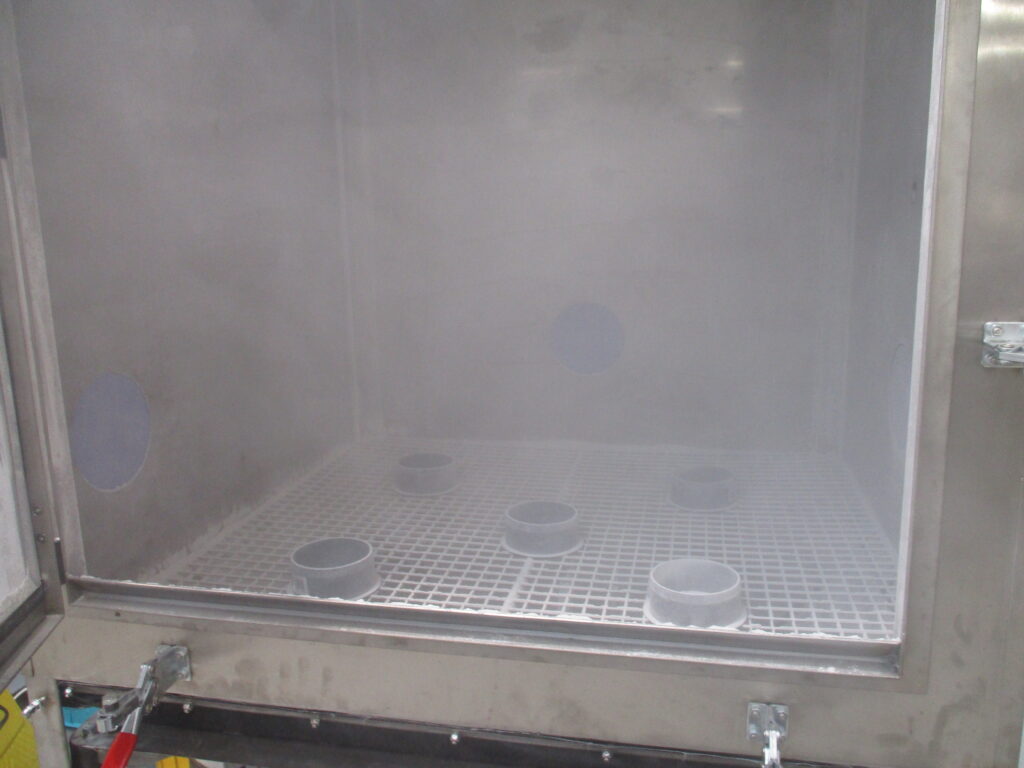
- Salt spray/salt fog and corrosive atmosphere testing
Low temperature cycling and soak
Thermal cycle testing is conducted to identify the failure mechanisms caused by a mismatch in the coefficient of thermal expansion (CTE) of materials. It is an accelerated life test used in evaluating product reliability, in addition to catching early-term latent defects by inducing failure through thermal fatigue.
Designed to simulate arctic, tundra and exposed environments in line with IEC 60068, MIL-STD-810 and DEF-STAN 00-35.
High temperature cycling and soak uses a single chamber system in line with IEC 60068. The ramp rate or transition time is limited by the chambers capability to go from one temperature to another and the thermal mass of the test specimen. The specimen is then held at a stabilised temperature before it makes its next transition. This is the soak time and allows manufacturers to enhance the chances of creating the failure mechanism they are most interested in trying to repeat. High temperature cycling and soak closely correlates to the hot, arid, semi-arid and desert environments in line with DEF-STAN 00-35.
Thermal cycle testing is conducted to identify the failure mechanisms caused by a mismatch in the coefficient of thermal expansion (CTE) of materials. It is an accelerated life test used in evaluating product reliability, in addition to catching early-term latent defects by inducing failure through thermal fatigue. Designed to simulate arctic, tundra and exposed environments in line with IEC 60068, MIL-STD-810 and DEF-STAN 00-35.
Temperature Cycling and Rapid Thermal Cycling tests can be achieved across a range of temperatures and transfer speeds. Our chambers are capable of up to 10⁰C per minute ramp rates across a range of temperature profiles. Temperature cycling allows products to undergo accelerated life testing and simulate the changes in temperature experience by products and devices in many environments: aerospace, marine, desert, arctic, tundra and many more areas.
Thermal shock testing
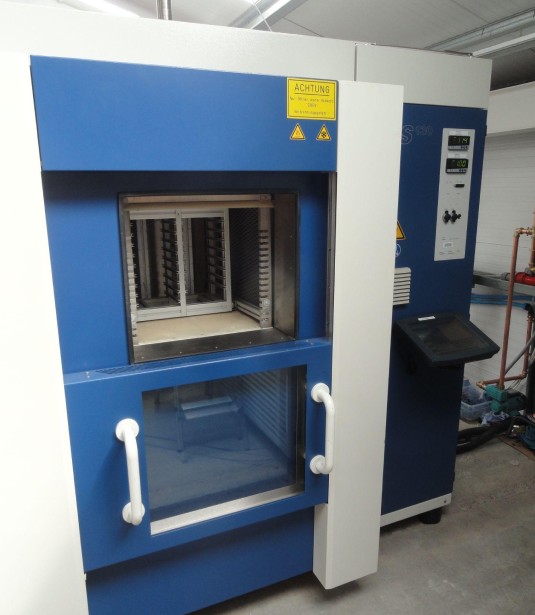
Thermal shock (DEF-STAN 00-35, MIL-STD-810, IEC EN 60068 for example) testing is the process through which a product is rapidly transferred between two extreme temperatures to determine its durability to changes in temperature and identify potential breaking points.
Thermal shock is intended to mimic the wear and tear that a product will experience, in usual conditions or standard use, in an accelerated environment. Sudden changes in temperature can cause physical elements to shatter, crack or warp in unintended ways.
Read more
Thermal shock testing is a great tool for determining the resilience of electronic, electromechanical, plastic, and mechanical products that will be deployed in the medical, consumer, aerospace, defence, or automotive industries (think of starting a car in the winter).
Consider the temperature variations the parts of an airplane experience as temperatures change as altitude increases or decreases, or the trauma inflicted on a GPS device used in wilderness terrain by field researchers. The ability of these electronics to function properly is often a matter of life and death.
At Resonate Testing, we will meet the testing requirements by either utilising 2 separate chambers at the extremes of temperature and manually lifting the DUT (Device Under Test) between chambers. We have chambers capable of reaching -86⁰C and +180⁰C.
Our automated Thermal Shock Chamber has 2 chambers:
- Hot chamber +60⁰C to +220⁰C;
- Cold chamber -10⁰C to -80⁰C
Combined temperature and humidity testing
Testing at elevated humidity levels (MIL-STD-810, IEC 60068, DEF-SATN 00-35, RTCA DO-160) tests a products resistance to water ingress, absorption and corrosion and measures its mechanical integrity. It also tests if moving elements of the mechanical system suffer from water ingress and if the electrical control system suffers from a moisture-induced short circuit.
Materials, such as composites, plastics and fabrics – such as those used in soft furnishings (blinds, covers, curtains), can also be tested in our chambers to simulate diurnal cycling in humid environments.
Combined altitude and temperature
To verify products remain operational and durable against the full range of environmental conditions to which they might be exposed, concurrently simulating temperature and altitude can help identify potential failures that may not manifest in each condition tested separately.
Widely utilised in the aerospace industry, testing the combined effects of temperature and altitude on electronic and electromechanical components to ensure their safety, integrity and performance during ground and flight operations. Our altitude chamber can achieve altitudes up to 75,000ft with a temperature range of-70°C to +130°C.